
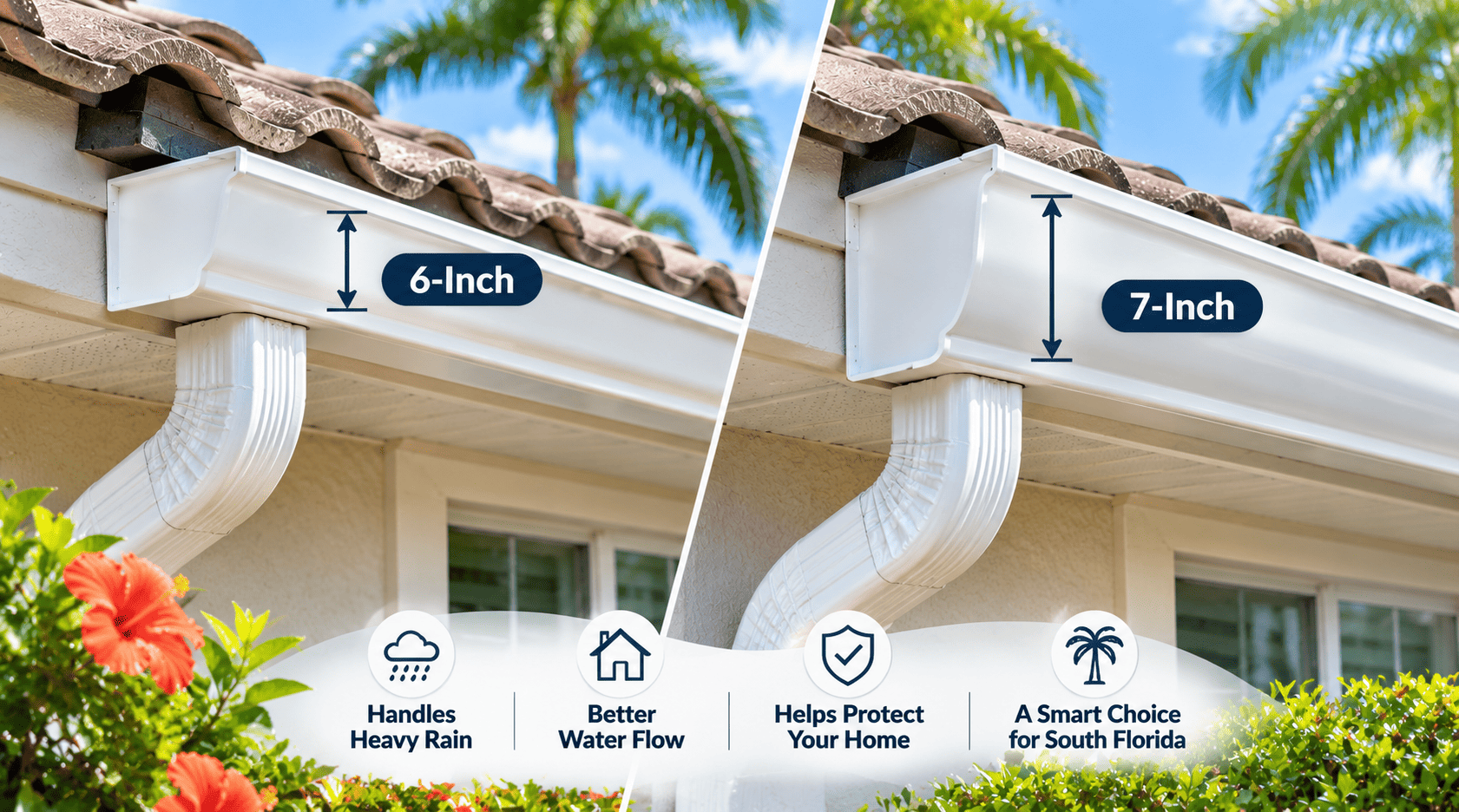
Neither 6-inch nor 7-inch gutters are automatically right for every South Florida home. Six-inch gutters can provide sufficient capacity for many residential roof sections, while a larger 7-inch system may be worth considering when a roof has large drainage areas, steep slopes, concentrated valley runoff, long gutter runs, or other high-flow conditions. Downspout size and placement are just as important as gutter width.
South Florida gutters regularly have to manage short, intense downpours rather than only light rain. The region’s wet season generally runs from May 15 through October 15, and accounts for a large share of the area’s annual rainfall, so gutter sizing should account for how quickly water can move off a roof during heavier conditions.
At K & B Seamless Gutters, we recommend looking at the entire roof-drainage system before deciding on gutter dimensions. Homeowners comparing seamless gutters in South Florida should consider roof area, pitch, valleys, gutter runs, downspout capacity, and where discharged water ultimately goes, not simply choose the larger gutter because it sounds better.
What Is the Difference Between 6-Inch and 7-Inch Gutters?
The stated gutter size generally describes the width of the gutter opening. A 7-inch gutter therefore has a larger opening than a comparable 6-inch gutter and can potentially accept and carry more runoff. However, width alone does not tell you the complete capacity of a gutter system.
Performance also depends on:
- Gutter profile and shape
- Roof drainage area
- Roof pitch
- Rainfall intensity
- Length of the gutter run
- Number and location of downspouts
- Downspout dimensions
- Roof valleys and intersections
- Gutter slope
- Debris or restrictions in the system
That is why comparing 6-inch vs. 7-inch gutters should be treated as a drainage-design question rather than simply a size comparison.
6-Inch vs. 7-Inch Gutters at a Glance
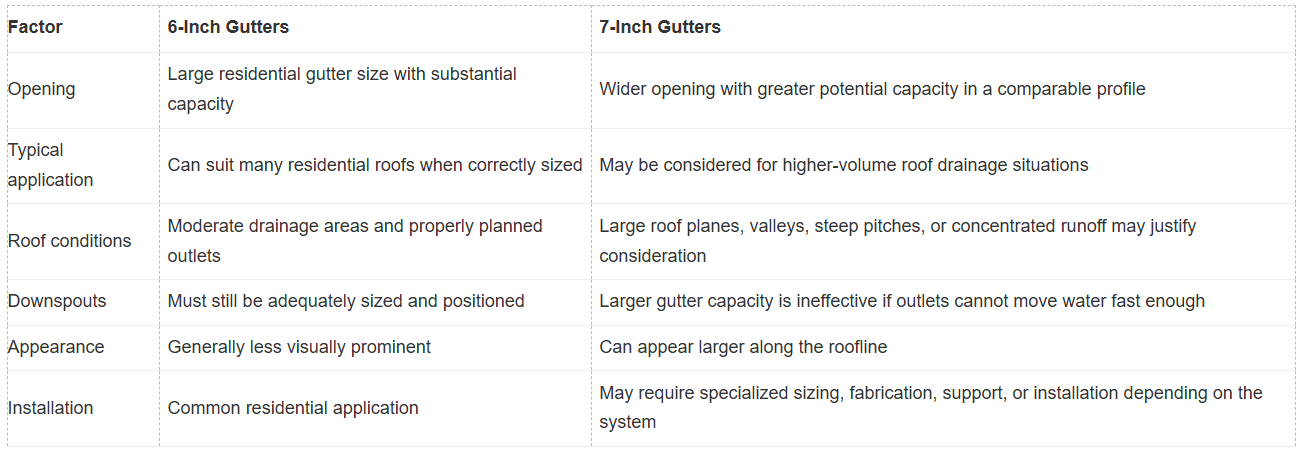
The table is a starting point, not a sizing formula. Two houses of similar size can require very different gutter configurations because their roofs distribute water differently.
When Can 6-Inch Gutters Be a Good Choice?
Six-inch gutters can work well for many South Florida residential applications when the drainage area feeding each gutter run is within the system’s capacity, and the downspouts allow water to exit efficiently.
They may be appropriate where:
- Roof planes are reasonably sized
- Water is distributed across multiple gutter runs
- There are enough downspout outlets
- Roof valleys do not overwhelm individual sections
- Gutter slope moves water properly toward the outlets
- The system is positioned correctly below the roof edge
A properly designed 6-inch system may outperform a larger gutter that has inadequate downspouts, poor slope, or incorrect placement.
That distinction is important because homeowners sometimes respond to overflow by assuming the gutters are too small. K & B’s existing guide to clean gutters that still overflow explains that capacity is only one possible cause.
When Might 7-Inch Gutters Be Worth Considering?
A larger 7-inch gutter may be considered when a roof places unusually high demand on specific sections of the drainage system.
Examples can include:
- Large uninterrupted roof planes
- Steep roof pitches
- Long gutter runs
- Several roof sections feeding the same area
- Large valleys concentrating runoff into a limited section
- Locations where heavy rain repeatedly overwhelms an otherwise clear system
A larger opening can provide additional room for runoff entering the gutter, but it should not be treated as an automatic fix.
If the real bottleneck is an undersized or poorly positioned downspout, simply increasing gutter width may not solve the overflow.
Depending on the gutter profile and installation system, 7-inch gutters may also require different fabrication, hangers, outlets, or support considerations. Homeowners should confirm the available system and specifications with their gutter contractor before assuming a particular size is offered or suitable.
Why Does Roof Drainage Area Matter?
The total square footage of the house is not the number that matters most for gutter sizing. The more useful measurement is the amount of roof surface draining into each gutter section. Consider two houses with the same living area.
One may have a simple roof with runoff divided evenly between several eaves. The other may have multiple roof planes and valleys directing a large share of the water toward one rear gutter.
The second house can place substantially more demand on one section even though the buildings have similar overall square footage. That is why professional gutter installation services should consider roof sections individually rather than choosing gutter size based only on the size of the home.
How Does Roof Pitch Affect Gutter Size?
Roof pitch changes how quickly rainwater reaches the gutters. A steeper roof can send water toward the eave more quickly during heavy rain, increasing the peak flow arriving at the gutter.
That does not automatically mean every steep roof needs 7-inch gutters. It means pitch should be considered alongside drainage area, rainfall intensity, valleys, gutter profile, and outlet capacity.
A neighboring home can therefore need a different gutter configuration even if both properties experience the same South Florida weather.
Why Are Roof Valleys Important?
Roof valleys can create some of the highest-flow areas on a gutter system. A valley collects runoff from multiple roof surfaces and funnels that water toward a relatively small section of the eave. During a heavy downpour, this can create a concentrated stream that overshoots or overwhelms a gutter even when nearby sections are handling rain normally.
Possible solutions depend on the actual configuration and can include:
- Additional gutter capacity
- Different gutter positioning
- Additional or relocated downspouts
- Changes to how water is directed through the system
The answer should be based on where the water is coming from rather than automatically increasing every gutter on the property.
Why Are Downspouts Just as Important as Gutter Size?
A gutter is only useful if the collected water has somewhere to go.
Downspouts act as the outlets for the system. If they cannot move water away quickly enough, water can accumulate in the gutter and eventually overflow even when the gutter itself has substantial capacity.
Important downspout considerations include:
- Number of outlets
- Outlet dimensions
- Location along the gutter run
- Length of the gutter run feeding each outlet
- Whether roof valleys concentrate water near an outlet
- Whether the downspout is restricted
- Where water is discharged at ground level
Adding or repositioning a downspout can sometimes address a performance problem more effectively than replacing the entire gutter with a larger size.
Does South Florida Rainfall Change the Sizing Decision?
Yes. Local rainfall intensity should be considered when designing a gutter system.
South Florida’s rainy season typically runs from mid-May through mid-October, and the National Weather Service reports that roughly 60% to 70% of the region’s average annual rainfall occurs during that period. The issue for gutters is not simply the yearly rainfall total. Short-duration downpours can send a large volume of water toward a roof edge in a short period.
That is why gutter sizing calculations typically consider local rainfall intensity together with roof area and pitch. However, homeowners should not assume that living in South Florida automatically means every house requires the largest available gutter. The design still needs to match the roof.
Are Seamless Gutters Better for South Florida Homes?
Seamless gutter installation reduces the number of joints along straight gutter runs because the sections are formed to fit the measured roofline rather than assembled from many shorter pieces.
Fewer joints mean fewer potential leak locations along the straight run, although seams are still required at corners, end caps, outlets, and other connections.
For homeowners evaluating seamless gutters, South Florida properties commonly use, the more important question is not simply whether the gutter is seamless. The completed system also needs appropriate sizing, attachment, pitch, outlets, and discharge.
A poorly configured seamless gutter can still overflow.
K & B Seamless Gutters provides seamless gutter installation and gutter services for properties in Palm Beach and Broward counties.
Does a Larger Gutter Require More Maintenance?
Gutter width does not eliminate maintenance.
Six-inch and larger gutters can still collect:
- Leaves
- Palm debris
- Seed pods
- Roof granules
- Twigs
- Other wind-blown material
A larger gutter may provide more capacity, but a clogged outlet can still cause water to back up.
Leaf guards may reduce the amount of larger debris entering the system, but they do not make gutters permanently maintenance-free. The gutter, guards, downspouts, attachments, and discharge areas still need to function correctly.
Our South Florida gutter maintenance checklist explains what homeowners should monitor throughout the year.
How Do You Know if Your Existing Gutters Are Too Small?
Overflow does not automatically prove that the gutters are undersized.
Before replacing a system with larger gutters, check whether the problem could involve:
- Blocked gutters
- Restricted downspouts
- Incorrect gutter slope
- Sagging sections
- Insufficient outlets
- Poor placement below the roof edge
- Concentrated runoff from a roof valley
- Water traveling too far before reaching a downspout
Observe where overflow occurs during rain when it is safe to do so.
If water spills only at a valley, that suggests a different problem than water overflowing along the full length of a gutter run.
Documenting the location of the overflow can help a contractor diagnose the system more accurately.
How Should You Choose Between 6-Inch and 7-Inch Gutters?
Instead of starting with “Which size is better?” start with “How much runoff does this part of my roof need to handle?”
A gutter assessment should consider:
- Roof drainage area: Determine how much roof feeds each gutter run.
- Roof pitch: Account for how quickly water reaches the eave.
- Valleys: Identify places where several roof areas concentrate runoff.
- Rainfall intensity: Consider South Florida’s heavier downpours.
- Gutter profile: Capacity depends on both size and shape.
- Downspouts: Make sure water can leave the gutter efficiently.
- Discharge: Determine where the downspouts send the water.
- Existing symptoms: Look for repeated overflow, staining, erosion, or standing water.
The goal is not to install the largest possible gutter. It is to design a system with appropriate capacity for the roof and drainage conditions.
Frequently Asked Questions About 6-Inch and 7-Inch Gutters
Are 7-inch gutters always better than 6-inch gutters?
No. A 7-inch gutter can provide more potential capacity than a comparable 6-inch system, but larger is not automatically better. If a 6-inch system is properly sized for the roof and has adequate downspouts, increasing the gutter width may provide little practical benefit.
Do South Florida homes need larger gutters?
Not automatically. South Florida’s heavy rainfall makes capacity important, but the correct gutter size depends on the roof drainage area, pitch, valleys, profile, downspout layout, and local rainfall intensity. Each home should be evaluated according to its actual drainage conditions.
Can larger gutters stop overflowing gutters?
They can help when insufficient gutter capacity is the actual problem. However, overflow can also result from clogged downspouts, poor slope, sagging sections, inadequate outlets, incorrect gutter positioning, or concentrated valley runoff. The cause should be identified before replacing the system.
Are downspouts more important with larger gutters?
Downspouts are essential with every gutter size. Increasing gutter capacity without providing enough outlet capacity can simply move the bottleneck elsewhere. The gutters and downspouts should be sized and positioned as one drainage system.
What is the advantage of seamless gutter installation?
Seamless gutters reduce the number of joints along straight gutter runs, which means fewer potential leak points along those sections. They still require properly installed corners, outlets, end caps, attachments, pitch, and downspouts to manage roof runoff effectively.
Choose the Gutter System That Fits Your Roof
There is no universal rule that every South Florida home needs 7-inch gutters or that 6-inch gutters will work for every roof. The right decision depends on how much roof area feeds each gutter section, how quickly the roof sheds water, where valleys concentrate runoff, and whether the downspouts can move that water away efficiently.
If you are planning a new gutter system or your current gutters repeatedly overflow during heavy rain, contact K & B Seamless Gutters to request an evaluation and discuss the drainage needs of your property.
For properties in Broward County, call (954) 790-8040. For Palm Beach County, call (561) 523-1019.